Read Pressure
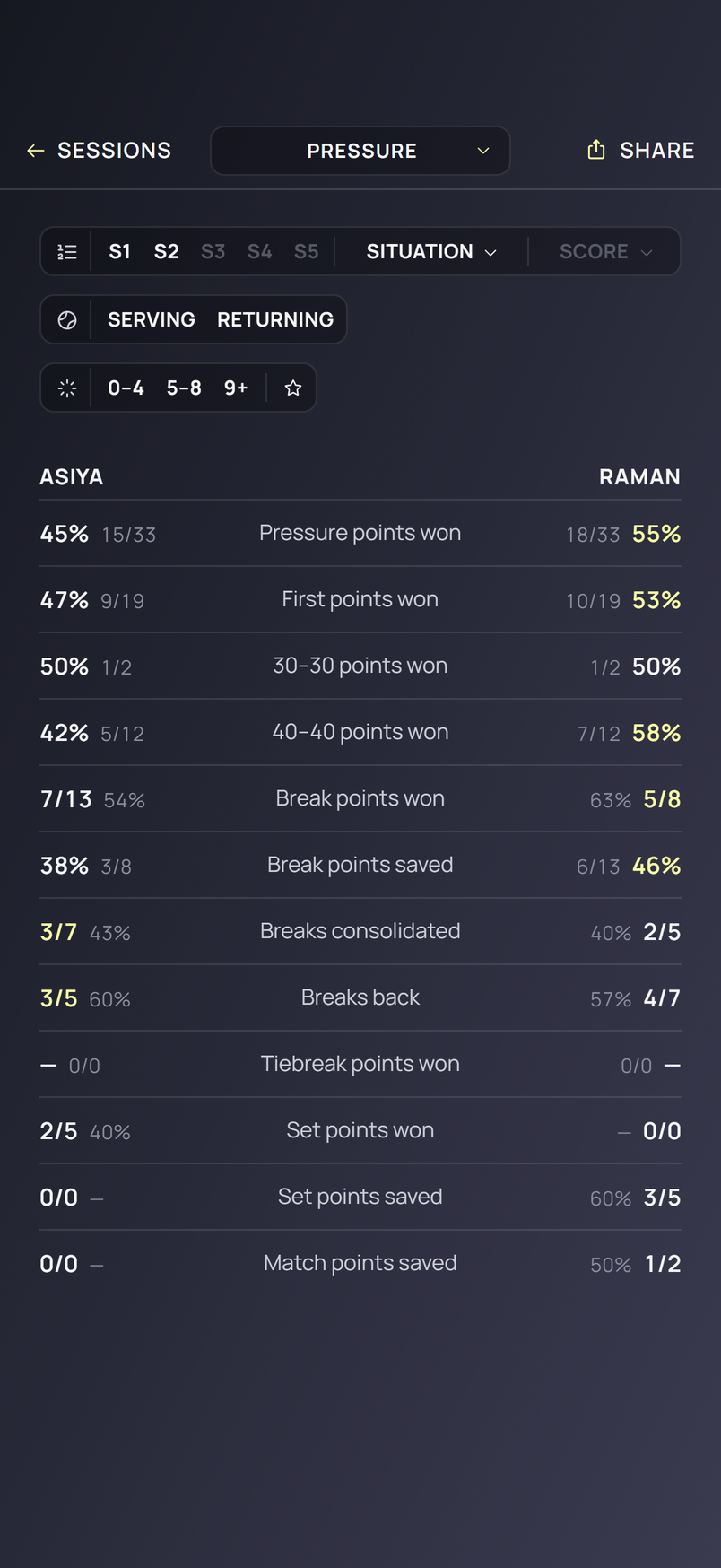
Pressure needs nothing but the score, so every match has it — and it answers the question parents ask most: does my player play the big points well? Every row is decided by the score before the point was played, never after, and each is read as a gap against the player’s overall rate.
- 1
The idea: the gap
Each row counts the points played at a named score and the share won. Read it against Points won on the Points page. Pressure points won ten points lower than points won is a player who tightens; ten higher is one who waits for the big points and coasts the rest. Within a few points of each other, the big points were played like the rest — which is its own good news.
- 2
Break points, both ways
Break points won is the player as receiver; Break points saved is the player as server. A player who converts few and saves many plays the big point well with the serve in hand and poorly without it; the reverse is a returner who presses and a server who folds. Together they say which side of the court the pressure work belongs on.
- 3
How games start and how they are decided
First points won says how games start. 30–30 and 40–40 say how they are decided — the points where one shot is the game. A player strong at 30–30 and weak at 40–40 plays the first big point well and the one after it tight.
- 4
Breaks consolidated and breaks back
Breaks consolidated is the row coaches watch most: the service game straight after a break, held or not. A break not followed by a hold was given straight back, and a low number here with a healthy break-point row means the match was lost in the game after the good news. Breaks back is the mirror — breaking straight back after being broken.
- 5
The closing rows
Set points won · saved and match points saved are the closing rows. A low set-point conversion with a high set-point save says the sets were long and tight, not that the player cannot close. Few set points in a match of many games is a player who was rarely in a position to close.
- 6
From a row to a practice format
A gap of ten points or more between the pressure rows and the overall row points at the practice format, not the stroke: play practice games from 30–30, serve second serves only, start practice sets at 4–4. Then check the same row on Stats under Situation → Break point over the next five matches.
Good to know
- All twelve rows come from the score, so a Score match has the whole page.
- Pressure turns the Score filter off, because each of its rows already names a score.
- A rally session has a tally, not a score, so it has no Pressure page.
- Read the counts under the percentages: 2 of 2 break points saved is a good afternoon, not a trait.
Keep exploring