Co-op sessions: count the run
A co-op session has no winner. Two players rally together and the count is the score: how long the ball stayed in play, how many times, who ended it and how. It is the consistency drill written down — and its report is the one place where the average and the median of something are read side by side, which is worth learning once.
- 1
Set it up
On Sessions → Rally → + New rally, choose Co-op as the mode and the two players — the second is a Partner, not an opponent. The formats are Timed 5 · 10 · 15 or Open; a co-op has no blocks and no target. Every run starts with a feed (the Start row is fixed on Feed): the count wants a ball kept in play, not a serve hit into a box. Tracking is always Detailed.
- 2
Play it
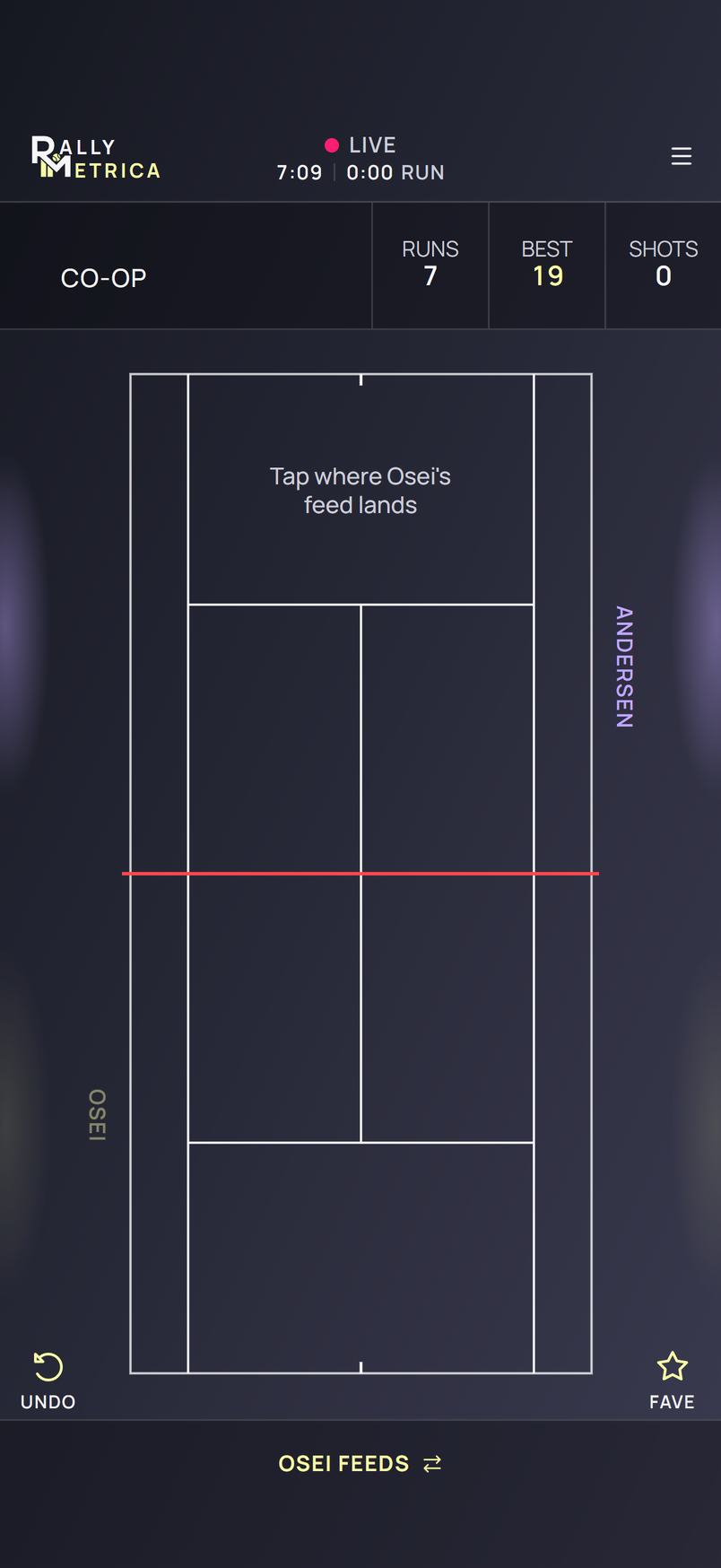
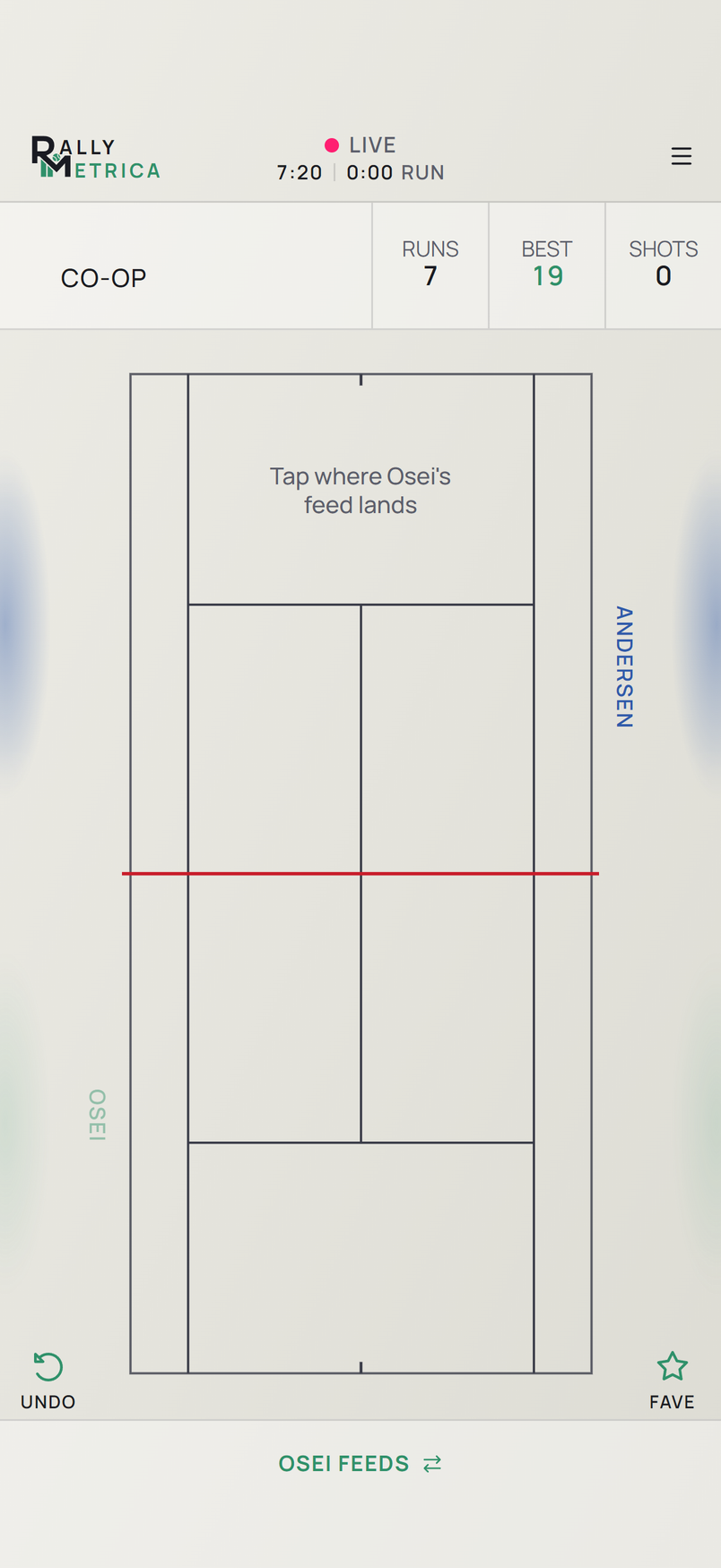
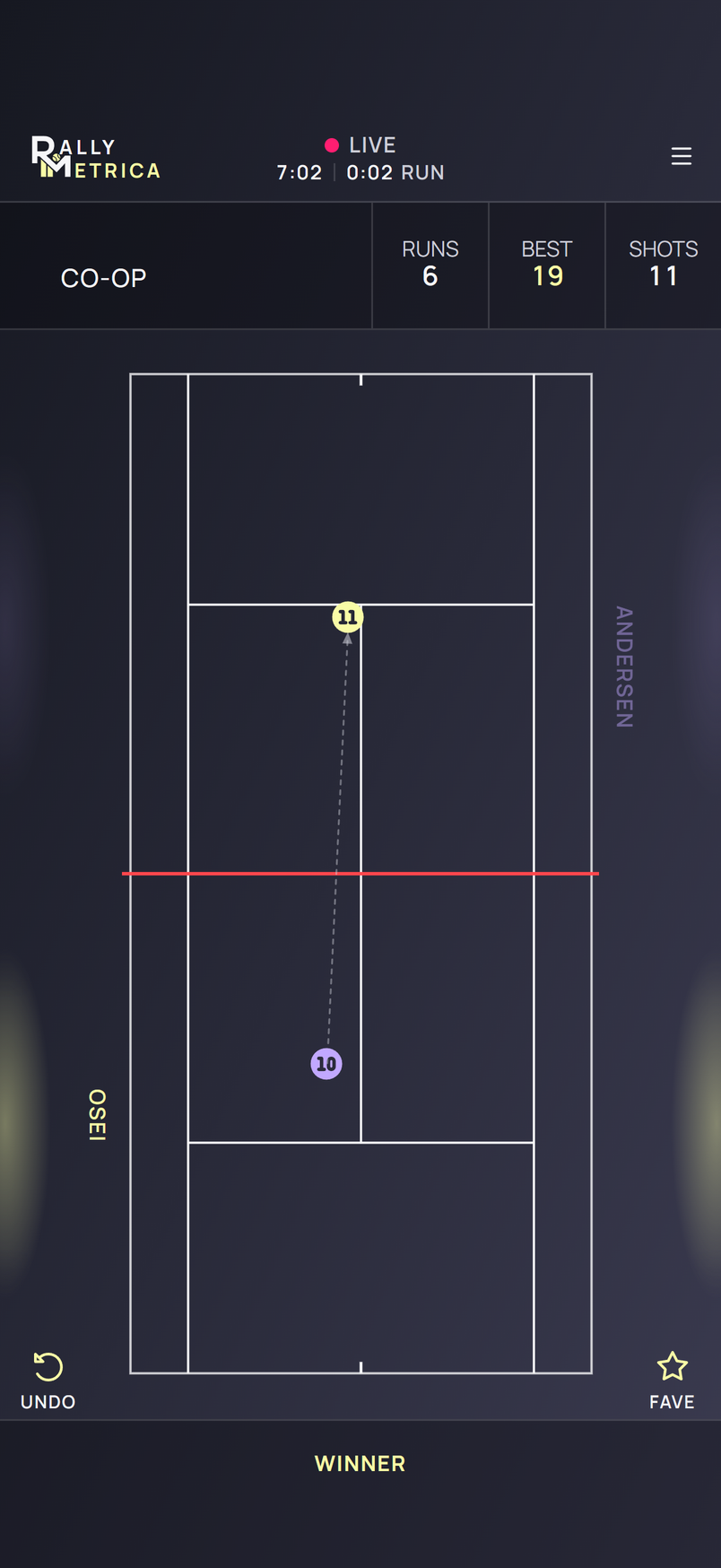
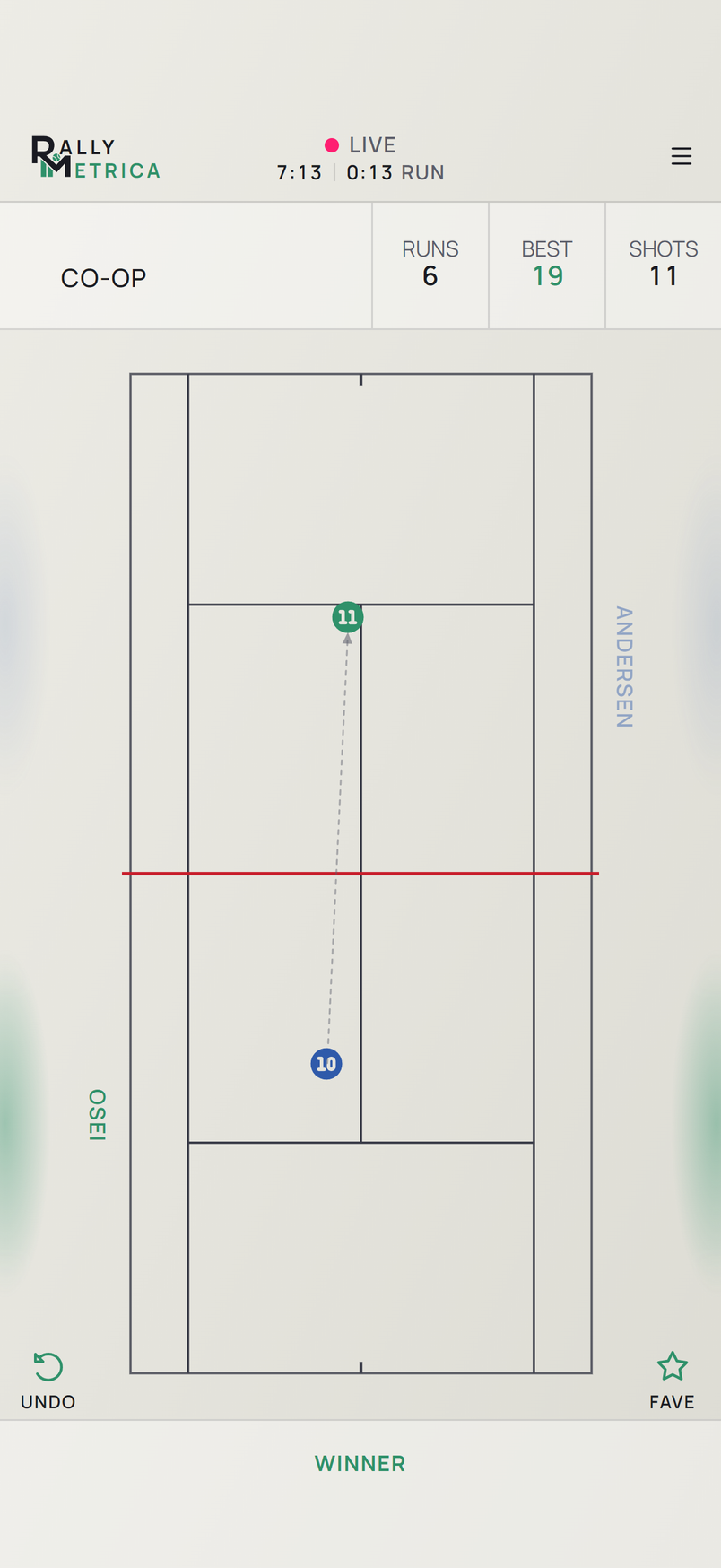
The board is one shared row — Runs · Best and the run in progress, the pair’s names above it. Who feeds is a pill between runs — Asiya feeds ⇄ — and a tap flips it: the one mid-session change allowed, because it changes no statistic. The feed is not counted; the receiver’s first ball is the first tap. Tap every landing as on the live court. Any miss ends the run — a ball outside the lines or in the net, or a ball in play the partner could not reach (unplayable) — and the run is saved with its balls, its seconds, who ended it and how. Undo reverses the last tap. The session ends on its clock or with End session.
- 3
Read the RUNS page: average and median
Every run is a bar, in order, the longest lit in the accent colour (yellow in dark mode, green in light) and the shortest in red. Two dashed lines cross the bars: the average and the median run. Read them together. The median is the run you can expect — half the runs were longer, half shorter — and it does not move when one run reaches forty. The average does: a few long runs pull it up. So an average well above the median means a session of short runs with a handful of long ones — the pair can rally, but not on demand. The closer the two lines, the steadier the pair. *Average 14 · median 9* and *average 10 · median 9* are two different pairs with the same median: the first one has a few spectacular runs, the second is consistent.
- 4
Read the cells
Beneath the bars, the session in numbers: Runs · Longest · Shortest · Average · Median · Over 10 · Balls · Balls a minute. Over 10 counts the runs that passed ten balls — the consistency target coaches actually set (“five over ten today”), and the number to compare week to week. Balls a minute is the pace over the runs’ own seconds, not the clock, so the walking between runs never dilutes it: 28 a minute is a pair hitting flat out, 18 is a controlled, deep exchange. A filter recomputes the bars, both lines and every cell from the lit runs alone, so a length filter or a starred run narrows the pace with the count.
- 5
Read ENDINGS
A run has no winner, only an ender. ENDINGS takes the Points page’s place and says who ended the runs and how: Runs ended (with each player’s share), Into the net, Long, Wide, Unplayable (in, but the partner could not play it) and Balls hit. Each ending points somewhere: net misses to height and margin over the net; long to over-hitting or late contact; wide to direction; unplayable to a ball the partner should learn to reach — or to a player who is not keeping to the task and is hitting winners in a co-op. A pair whose misses are nearly all long is swinging too hard for the drill; nearly all net is playing too safe.
- 6
Read the per-player rows
Under the RUNS chart each player has Balls hit, Balls a minute, Runs ended, and the Average · Median · Longest run they ended. Runs ended says who the weaker link was; the three run figures say in which kind of run. A player who ends the short runs misses early — the first balls after the feed; one who ends the long runs loses concentration late. Balls hit should be nearly equal in a co-op; a gap means one player is taking two balls to the other’s one, which the Timeline will show.
- 7
Read the rest
Placement reads the rally balls and the ending balls (Rally · End, one at a time), as a table or on the court: a deep share under 40% is the depth the misses were made of; the End court shows where the misses went. Patterns reads attempts with no won — there are no points to win — which makes a co-op the cleanest place to drill a sequence. Timeline lists every run — Run 7 · 23 balls · ended · net — with its seconds. There is no Momentum, Aggression, Serve, Return or Pressure: a co-op has no points and no serve.
Good to know
- Sessions are not charted on the Stats tab; the RUNS page is a co-op’s trend, and Over 10 is the number to compare across sessions.
- The feed is never counted and a bad feed is fed again: a run is the balls kept in play after it.
- A linked coach receives a co-op live like a match, with a notification at its start and end.
Keep exploring