Read Points, Serve and Return
These three pages hold the numbers most people look for first: points won, first serve in, winners and errors. A number on its own rarely means much. This guide is about which two to read together — and what each pairing says about the player.
- 1
Points: Games won, and the counts under the percentages
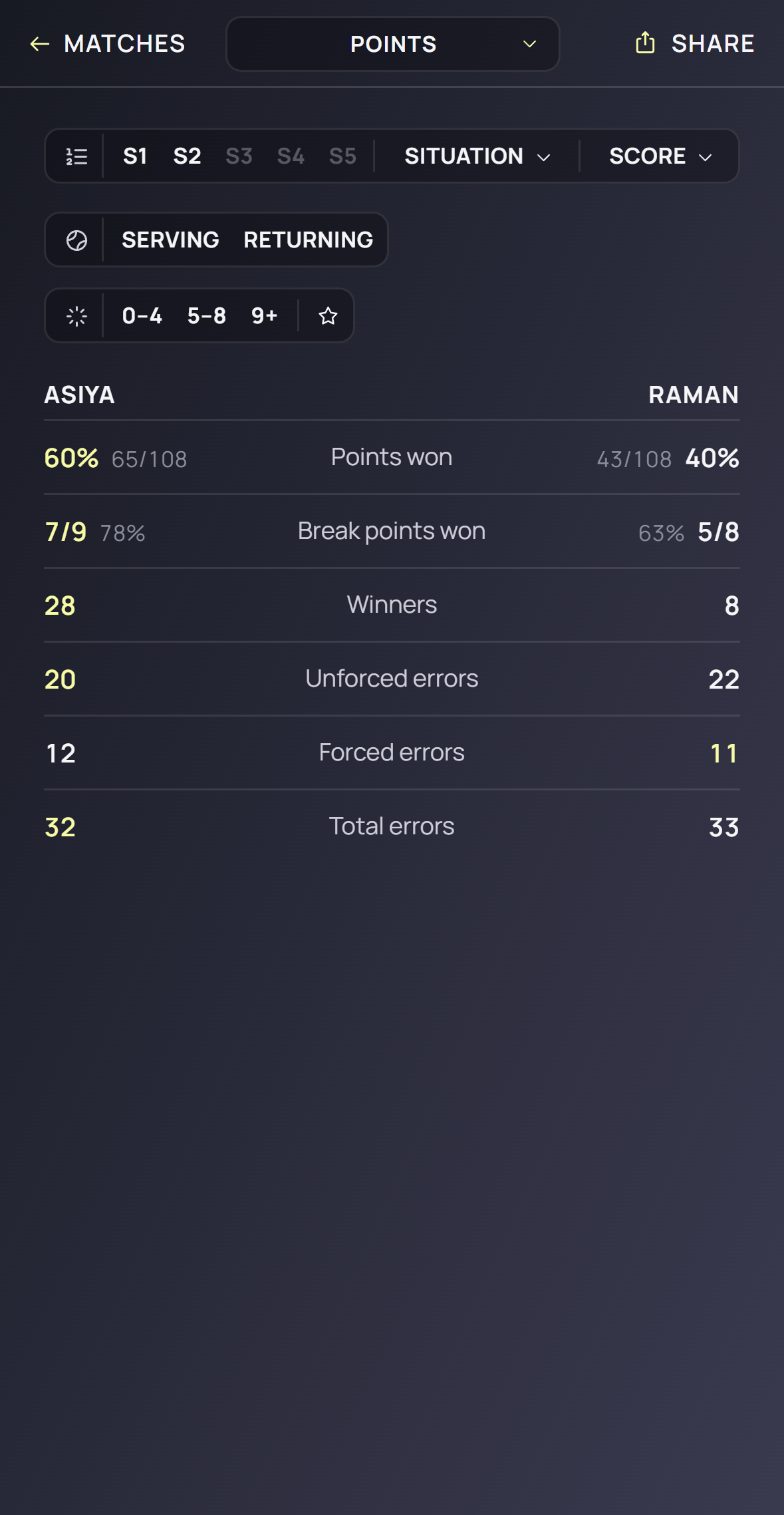
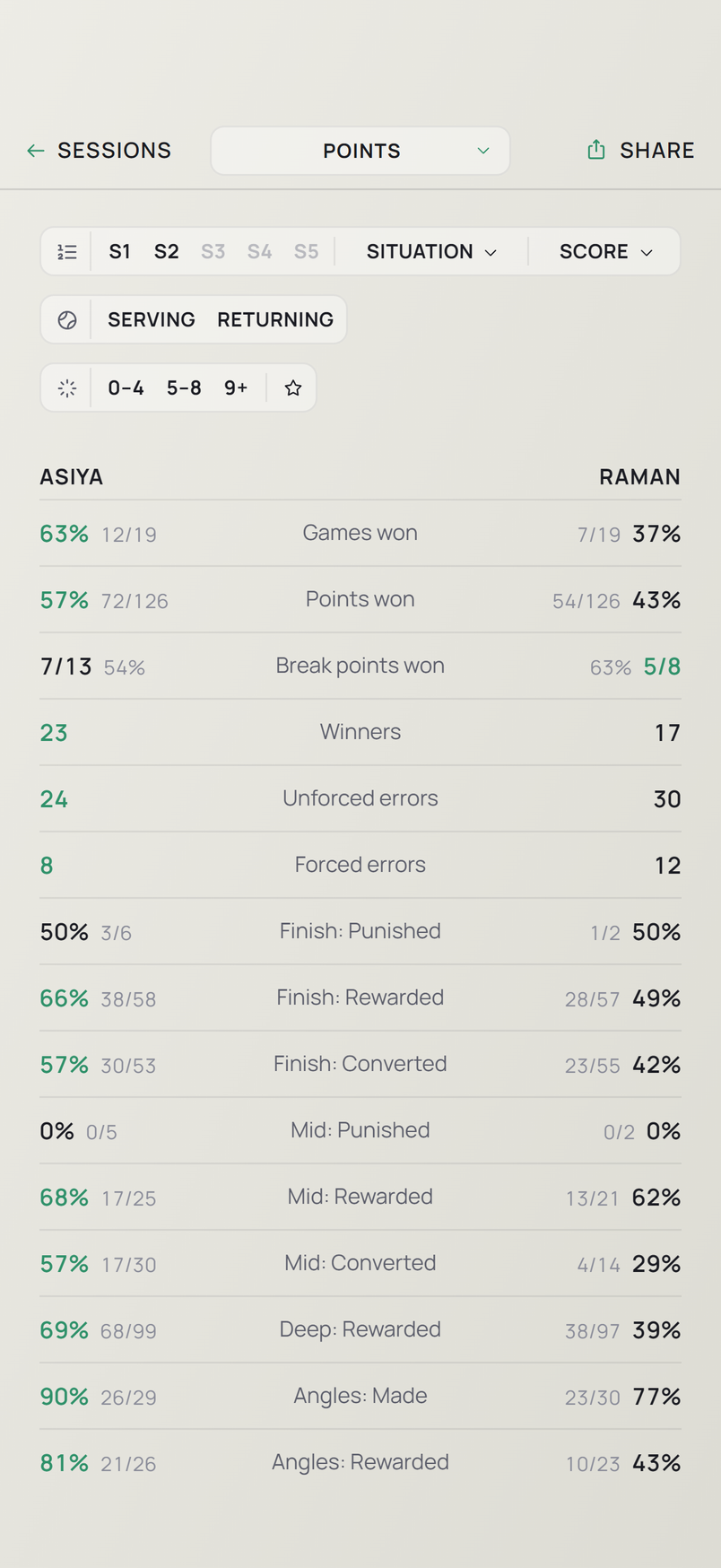
Games won heads the table: the score with no filter, and under the filters the games those points fall in — holds under Serving, breaks under Returning. The table lights the better side of each row, with the fraction under each percentage. Always glance at the counts: 67% of three points is noise.
- 2
Pair one: points won against break points won
52% of all points but 1 of 5 break points is not a tennis problem, it is a pressure problem — the Pressure page will confirm it. The reverse — a modest share of points and most of the break points — is a player who was outplayed in the rallies and still found a way.
- 3
Pair two: winners against unforced errors
More winners than unforced errors is a match played on the player’s terms; the reverse means the opponent only had to keep the ball in. Winners here are rally winners; the serve’s own winners sit on the Serve page as Service winners, so a big server’s free points are counted there, not here.
- 4
Pair three: forced against unforced errors
A forced error is a miss the opponent’s good shot caused; an unforced error is a miss on a ball the player had time to play. Forced errors are the opponent’s good play, unforced are the player’s own to fix. A player with twice as many forced as unforced was beaten; one with the reverse beat themselves.
- 5
Serve: read it as a chain
Serve opens with Games won — service games held — then reads top to bottom. 1st serve in high with 1st serve points won low is a serve that goes in but goes nowhere — look at Serves T · middle · wide (Detailed) for a serve that always goes to the same place. 1st serve in low with 1st serve points won high is a big serve that misses too often: a percentage problem, not a weapon problem. 2nd serve points won under 40% with double faults present is the second serve, and it is the row most matches are decided on. Aces and service winners are the free points; if both are near zero against a weak returner, the serve is a start-the-point shot, not a weapon.
- 6
Return: the other side of the chain
Return opens with Games won — return games won — and is the receiver’s side of the same points. Return in low on first serves is position and reaction; on second serves it is intent — a second-serve return that keeps missing was being attacked too hard. Return points won against second serves is the single best measure of whether a player punished the opponent’s weakness.
- 7
The serve tracks
On Detailed matches both pages carry the Deuce · Ad and T · Mid · Wide tracks. Read 2nd serve points won from the ad court alone before deciding the second serve is fine; read 1st serve points won by zone before deciding the serve has no weapon — a serve that wins from the T and loses out wide is a placement fact, not a serve fact.
Good to know
- Games, points won and break points need only the score. Winners and errors, and the Serve and Return pages, need a Counter match; the zone tracks need Detailed.
- A dash is a value not captured at this tracking level, or no points under the filter — never a zero.
- Rally length (0–4 · 5–8 · 9+) belongs to the whole point: on Serve, 9+ reads which serves started the long rallies.
Keep exploring