Read Aggression
Points won says who won. Aggression says how: who built the points and who gave them away. It needs a Counter or Detailed match, because it reads how each point ended — and it is the page that catches the player who never misses but loses anyway.
- 1
Built against given away
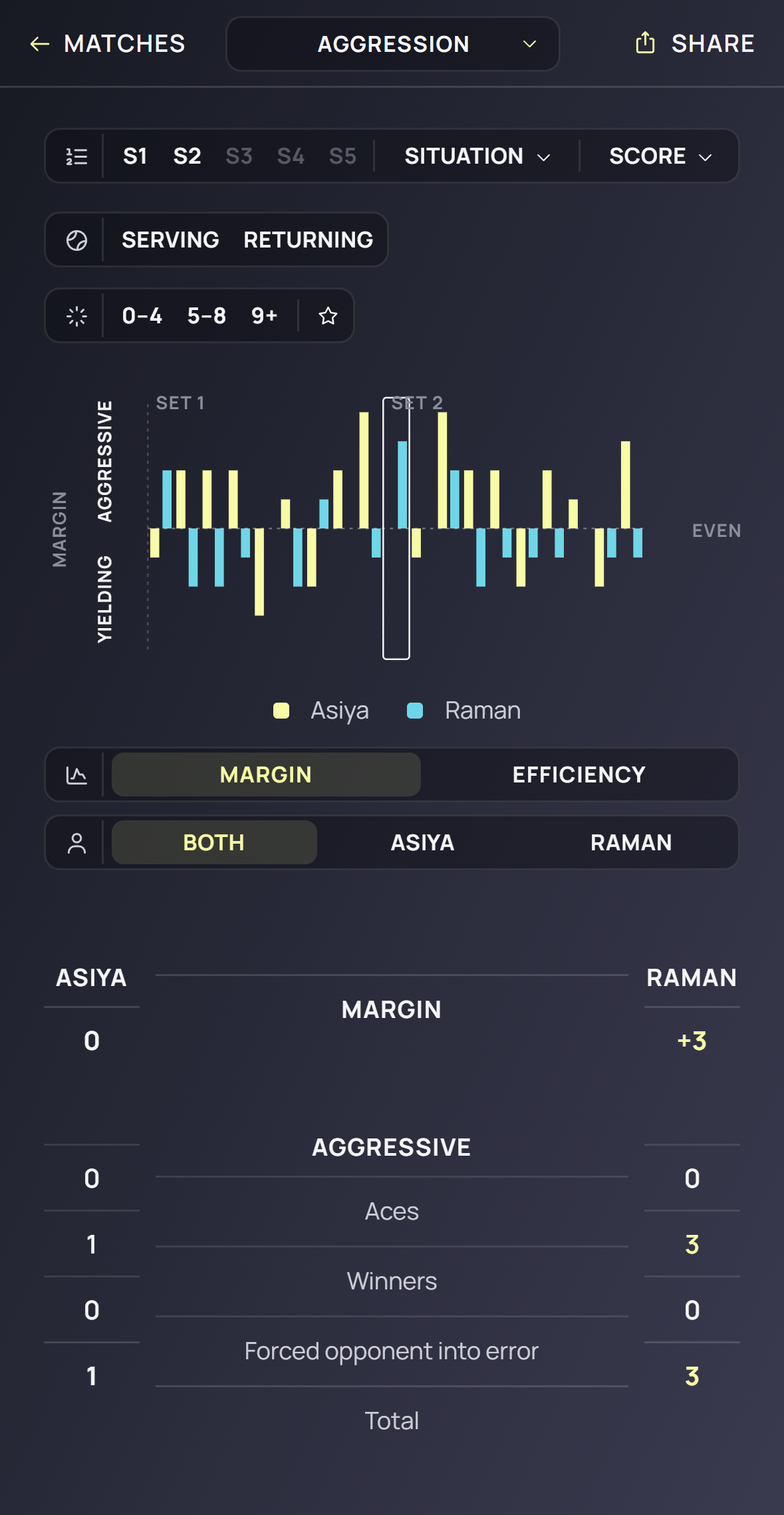
Every decided point is either built — an ace, a service winner, a winner, or an error the opponent was forced into — or given away: an unforced error or a double fault. Margin is points built minus points given away. Above zero, the player made more happen than they handed over; below, the opponent only had to keep the ball in.
- 2
The line
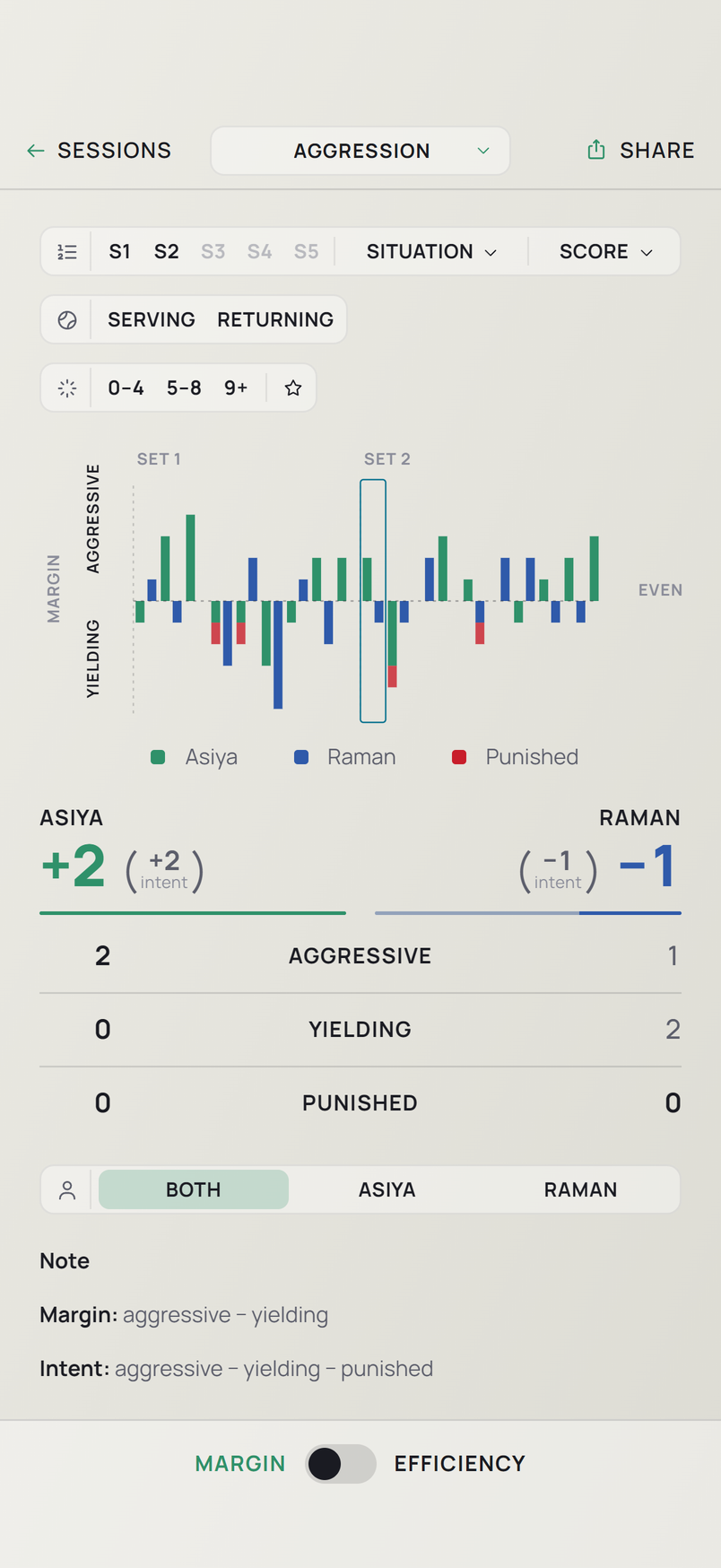
The line is one player’s running margin or efficiency through the match, game by game: aggressive above EVEN, yielding below. Read where it crosses EVEN against Momentum’s swing: a form line that dropped under even a game before the curve did is the warning the score had not shown yet.
- 3
Intent margin and the four sections
Beneath the line two headline rows — Margin, and Intent margin, which also takes off the points a player was Punished for — then four sections you open with a tap: Aggressive (aces, service winners, winners, forced errors drawn from the opponent), Yielding (unforced errors, double faults), Punished (points lost after the player’s own short ball) and Opponent credit (forced errors the opponent simply earned). The bars stack the punished points in red under the given side, so the bar’s full length is the intent margin.
- 4
Punished: the short ball
A punished point is one lost after the player’s own short, central ball — a ball that fell in the opponent’s Finish zone inside the channel and invited the attack. Only a Detailed match can see it, because it needs the landing; on a Counter match every forced error is credited to the attacker. A player with a small margin and a much smaller intent margin is the one who never misses but feeds the opponent’s forehand all afternoon. Placement’s Finish: Punished row says how often that short ball cost the point.
- 5
Three readings
If Yielding is the bigger section, the problem is errors — margins and shot selection. If Punished is large, the problem is depth. If Aggressive, Yielding and Punished are all small, the player made nothing happen and the opponent decided the match — a passivity problem. Under ten decided points the rows read a dash: a short match says nothing about aggression.
- 6
Ask when
Switch Momentum’s currency to Aggression to see when in the match the dictating stopped — the form line over the last dozen points, game by game. Then the Set filter here shows that set’s sections on their own.
Good to know
- Aggression needs a Counter match; Punished needs the landings of a Detailed one.
- The rows read a dash under ten decided points.
- The practice-plan guide reads this page second, after Momentum’s swing.
Keep exploring